




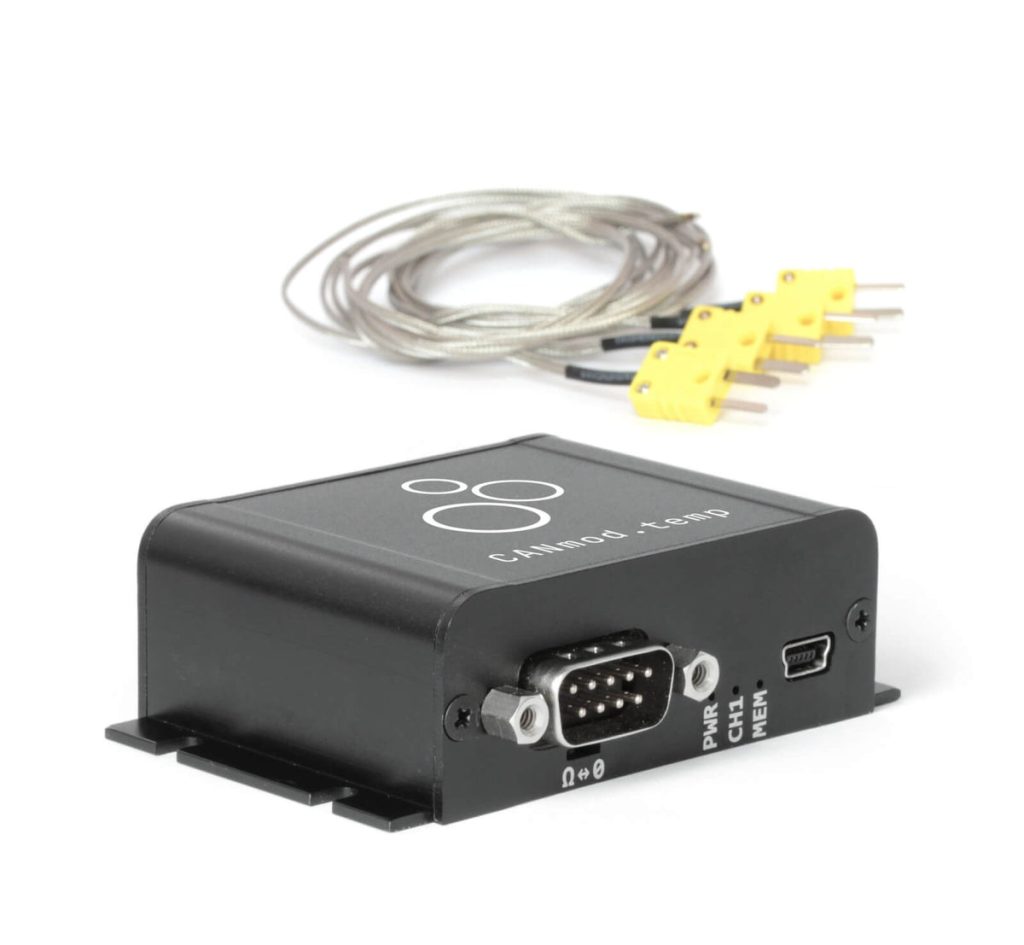
CANmod.temp: Thermocouple to CAN Module
The CANmod.temp is a thermocouple to CAN module with four channels. Temperatures that the vehicle does not report itself, such as exhaust, brake, battery cell or coolant line, are often exactly what a test needs. The CANmod.temp reads up to four thermocouples and sends calibrated temperatures in degrees Celsius over CAN.
It handles cold-junction compensation and linearization internally, flags broken or out-of-range probes, and works with all common thermocouple types. Connect it to a CANedge and the temperatures are logged on the same timeline as the rest of the bus.
Highlights
- 4 thermocouple channels plus ambient (cold-junction) temperature
- Thermocouple types B, E, J, K, N, R, S and T
- -210 °C to +1800 °C, depending on probe type
- Output in °C at 1 °C or 0.01 °C resolution
- Open-probe and over/under-temperature fault reporting
- 50/60 Hz line-noise filtering; DBC file included

Where it earns its keep
- Exhaust and aftertreatment testing: log EGT and catalyst temperatures alongside engine data
- Brakes and drivetrain: monitor disc, gearbox and bearing temperatures during validation
- EV batteries: add independent temperature points to battery pack tests
- Industrial equipment: track process and motor temperatures on machines with a CAN network
Key Specifications
| Spec | Value |
|---|---|
| Function | Reads 4 thermocouples and outputs temperatures on CAN (or USB) |
| Channels | 4 thermocouples plus cold-junction (ambient) temperature |
| Converter | MAX31856 precision thermocouple converter |
| Thermocouple types | B, E, J, K, N, R, S, T (configurable per channel) |
| Range | -210 °C to +1800 °C, depending on type |
| Resolution | 1 °C (one CAN frame) or 0.01 °C (two CAN frames) |
| Cold-junction accuracy | ±0.7 °C max (-20 °C to +85 °C) |
| Fault detection | Open thermocouple, over- and undertemperature, reported via CAN |
| Noise filtering | 50 Hz or 60 Hz line-frequency rejection |
| CAN output | 1 x CAN, 5 kbit/s to 1 Mbit/s; broadcast or on request; configurable IDs and rates |
| Connectors | DB9 (CAN and power), 4 x miniature thermocouple sockets |
| Enclosure | Aluminium, 65 x 48 x 24 mm, 80 g, 3 LEDs |
| Power | +5 to +26 V DC via the DB9 connector (pin 1 or 9); under 1 W |
| Configuration | JSON configuration files (same concept as the CANedge), via USB |
| USB | Mini USB for configuration, firmware updates and live streaming |
| Operating temperature | -25 °C to +70 °C |
| IP rating | IP40 |
| Made in | Denmark |
Frequently asked questions
Which thermocouple probes can I use?
Any type B, E, J, K, N, R, S or T probe with a miniature thermocouple plug. Type K is the most common general-purpose choice. On metal surfaces, use isolated probes.
Does a CANmod need a PC or a logger to work?
No. Once configured, it runs on its own from the DB9 power pins and puts its data straight onto the CAN bus. A PC is only needed over USB to change the configuration, update firmware or watch the data live.
How do I decode the CAN messages it sends?
CSS Electronics provides a DBC file describing every message and signal the module outputs, so any DBC-capable tool, including the CANedge software and asammdf, shows the values directly in engineering units.
Need a quote or help choosing the right setup? Contact Pertech, the CSS Electronics distributor in Israel.
