




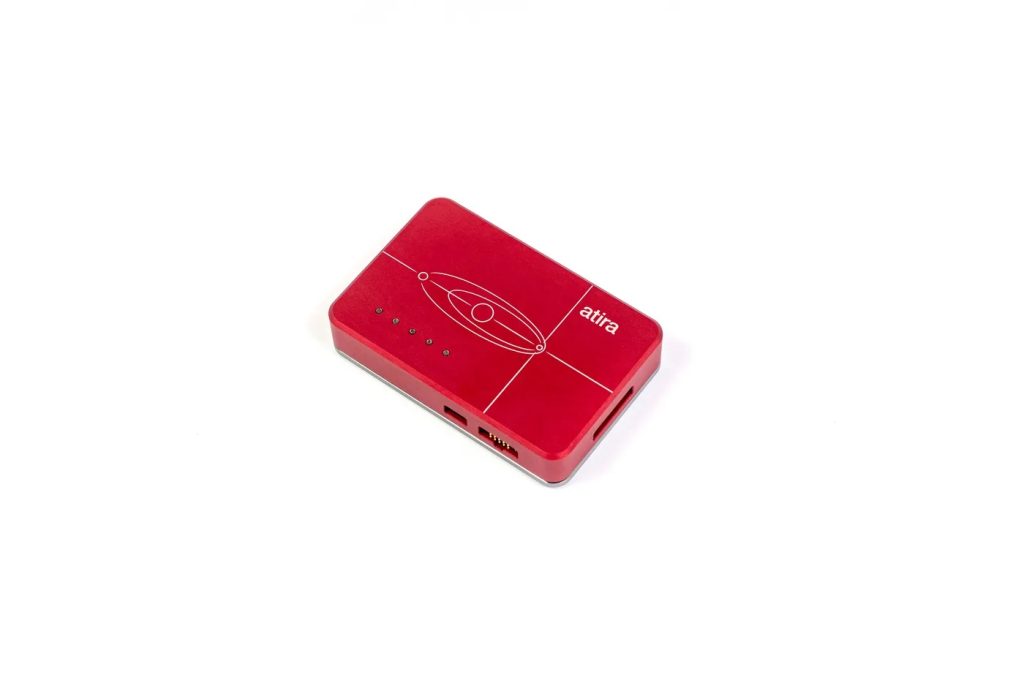
Binho Atira: Debug, Program and Power Your Target from One Probe
Binho Atira is a USB-C debug probe and programmer for embedded developers. It debugs Arm Cortex-M targets over SWD and JTAG, captures SWO trace and RTT, programs SPI flash and EEPROM, bridges the target’s serial console, and powers the board from a programmable 1.2 to 5.0 V supply while it measures voltage, current and power. On most bring-up benches, one aluminum box replaces the debug probe, the USB-to-serial cable and the bench supply.
Pertech is Binho’s authorized distributor in Israel. Atira is available to order now, and Binho begins shipping on November 9, 2026.
Highlights
- Standard CMSIS-DAP v2 probe: works with pyOCD, OpenOCD and CMSIS-DAP-aware IDEs, with no vendor plug-in needed for core debug
- SWD, JTAG, SWO trace and RTT, with RTT streaming while a debug session runs
- SPI controller up to 24 MHz for SPI flash and EEPROM programming
- USB-to-UART bridge up to 2 Mbaud with optional RTS/CTS, plus a second, read-only port to monitor the traffic
- Programmable target supply from 1.2 to 5.0 V with live voltage, current and power readings
- Level translation on every target-facing signal, 1.2 to 5.0 V
- Power-cycles the target from software, without unplugging a cable
- Binho Mission Control GUI, plus Python and C/C#/C++ SDKs, on Windows, macOS and Linux
- Driverless USB and field-upgradeable firmware
- Microchip PIC (ICSP) and AVR (UPDI) programming in development, with pre-release access from Binho
Where it earns its keep
- Board bring-up. Power the board at the right voltage, watch its current, open the console and attach the debugger, all over one USB-C cable.
- Firmware development and debug on Arm Cortex-M: breakpoints, stepping, memory and register access, flash programming.
- Automated hardware and firmware testing. Script power cycles, flashing and console checks from Python or C, in CI rigs and agent-driven workflows.
- SPI flash and EEPROM programming for firmware images and calibration data.
- Production-line MCU programming. Run many Atira units from one PC as a gang programmer, and bolt each one into a fixture through its two M3 mounting holes.
- Device driver development and proof-of-concept work, with the target’s serial output visible while you debug.
What’s in the box
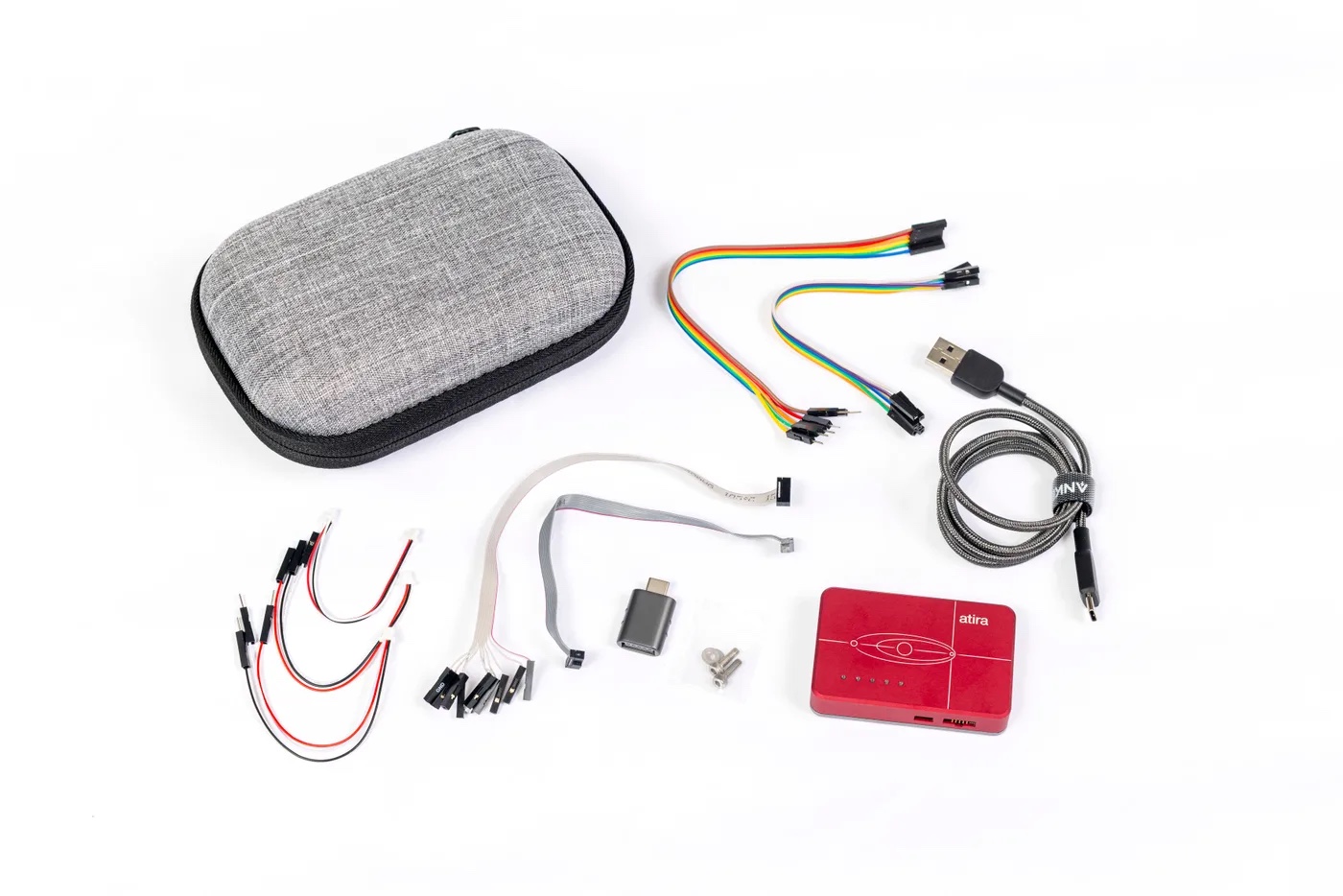
- Binho Atira USB adapter
- Programming port kit: 2×5 pin 1.27 mm IDC ribbon cable, and a second with 2.54 mm female headers
- 6-pin serial port kit: cables with male and with female 2.54 mm headers
- 3-pin UART kit: JST SH 1.0 mm cables with male headers and with a JST SH plug
- USB Type-C to Type-A cable and USB Type-A to Type-C adapter
- Mounting kit: 2 screws and 2 washers
- Protective zippered carry case
Pairs well with
For hands-free probing, Binho recommends Sensepeek PCBite probes, which Pertech also supplies: see Sensepeek PCBite. For I2C, SPI, UART, RS-485 and I3C work beyond debug, see the Binho Pulsar host adapter and the Binho Supernova I3C adapter. All Binho products: Binho in Israel.
Key Specifications
| Spec | Value |
|---|---|
| Product | Binho Atira USB debug probe and programmer |
| SKU | BIN109 |
| Host interface | USB 2.0 Full-Speed (12 Mbps), USB Type-C, bus-powered, driverless (HID + CDC) |
| Debug standard | CMSIS-DAP v2 |
| Debug and trace | SWD, JTAG (TCK, TMS, TDI, TDO, nTRST, nRESET), SWO, RTT |
| Supported debug targets | Arm Cortex-M (SWD); devices with JTAG-DP or JTAG TAP |
| Microchip programming | ICSP (PIC) and UPDI (AVR): in development, pre-release access from Binho |
| SPI | Controller; modes 0 to 3; 10 kHz to 24 MHz; 8 or 16 bit; MSB or LSB first; up to 16 KB per transfer; 1 CS |
| UART | 600 baud to 2 Mbaud; 7 or 8 data bits; parity none, even or odd; 1 or 2 stop bits; optional RTS/CTS |
| Target I/O voltage | 1.2 to 5.0 V, level-shifted on every target-facing signal |
| Target supply | Programmable 1.2 to 5.0 V in 1.1 mV steps; 500 mA recommended maximum per port; available current depends on the USB host port |
| Power monitoring | 16-bit; current 0 to 2.048 A (62.5 µA resolution); voltage up to 5.5 V (1.6 mV resolution) |
| Target ports | 2×5 pin 1.27 mm programming port; 6-pin 2.54 mm serial port; 3-pin JST SH 1.0 mm UART port |
| Software | Binho Mission Control GUI; Python (3.10+) and C/C#/C++ SDKs; Windows, macOS, Linux |
| Enclosure | Machined aluminum, 5 RGB status LEDs, 2 M3 mounting holes, fanless |
| Operating temperature | 0 to 70 °C |
| ESD rating | ±4 kV |
| Datasheet | Binho Atira datasheet, Rev 1.1 (PDF) |
Frequently Asked Questions
What is Binho Atira?
Binho Atira is a USB-C debug probe and programmer from Binho. It debugs Arm Cortex-M targets over SWD and JTAG, captures SWO and RTT, programs SPI flash and EEPROM, bridges the target’s UART, and powers the target from a programmable 1.2 to 5.0 V supply with live voltage, current and power monitoring.
Which debug tools work with Binho Atira?
Atira is a standard CMSIS-DAP v2 probe, so it works with pyOCD, OpenOCD and IDEs that support CMSIS-DAP probes, with no vendor-specific plug-in for core debug. Arm Keil MDK supports CMSIS-DAP debug adapters; see Arm Keil MDK, and ask us to confirm your device.
Can Binho Atira power my board?
Yes. Atira can power the target from 1.2 to 5.0 V and measure its voltage, current and power continuously, or it can leave a self-powered target alone and match its I/O voltage. The current available depends on the USB host port. Atira’s monitoring is meant for functional checks and logging; for low-power or battery-life characterization, use a dedicated power analyzer.
Does Atira program Microchip PIC and AVR devices?
ICSP for PIC and UPDI for AVR are in active development. UPDI is planned for tinyAVR 0/1-series, AVR DA/DB and AVR DD/EA. Binho offers pre-release access; contact us and we will arrange it.
Can I use Binho Atira for production programming?
Yes. Many Atira units can run from one PC for gang programming and automated test stations, controlled from the Python or C/C#/C++ SDK. The aluminum enclosure has two M3 mounting holes, and the ports use standard off-the-shelf connectors for custom fixtures.
How is Atira different from Binho Pulsar and Supernova?
Atira is a debug probe and programmer for microcontrollers. Binho Pulsar is a multi-protocol USB host adapter for talking to I2C, SPI, UART and RS-485 devices. Binho Supernova is an I3C and I2C host adapter. Many teams use Atira for firmware and a host adapter for the peripherals around it.
Where can I buy Binho Atira in Israel?
From Pertech, Binho’s authorized distributor in Israel. We provide quotes in Israel, local delivery and technical support. Request a quote.
Need a quote, a demo or help choosing between Binho tools? Contact Pertech.
