



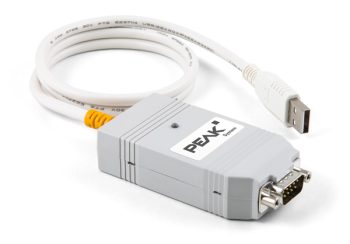
The Peak System PCAN-PLIN is a PC interface designed for connecting a computer to LIN (Local Interconnect Network) and CAN (Controller Area Network) buses. It supports LIN communication as well as CAN, allowing for monitoring, data logging, and control of both network types. The PCAN-PLIN interface is especially useful for automotive and industrial applications, where LIN and CAN buses are commonly used for communication between different vehicle or device components.
Key Features:
1. Dual Support: LIN and CAN:
- Supports both LIN (Local Interconnect Network) and CAN (Controller Area Network) protocols, allowing interaction with devices on both types of networks.
- LIN is typically used for lower-speed, cost-effective communication, such as in automotive body electronics, while CAN is used for higher-speed, critical communications like engine control.
2. PC Connection:
- Provides a reliable connection between a PC and LIN/CAN bus via USB or PCI Express, depending on the version. The interface is useful for monitoring and controlling network traffic.
3. LIN Features: LIN Master and Slave Modes:
- The device can act as a LIN master node or slave node, enabling it to interact with all types of LIN nodes on the bus.
- Baud rate ranges from 1 kbit/s to 20 kbit/s for LIN.
- Supports LIN protocol versions 1.x and 2.x.
- The ability to simulate LIN master nodes, log data, and test LIN bus communication.
4. CAN Features:
- Fully compatible with ISO 11898-2 (High-Speed CAN) and ISO 11898-5 (low-power CAN).
- Supports CAN data rates up to 1 Mbit/s.
- Includes termination resistor for the CAN bus.
5. Driver and API Support:
- Drivers and libraries are available for Windows and Linux operating systems.
- PCAN-Basic API allows for integration into custom software applications for monitoring and controlling the LIN and CAN networks.
6. Error Detection and Debugging:
- Includes error detection and diagnostic capabilities, with error frames, bus load monitoring, and more.
- Status LEDs provide visual feedback on the status of the LIN and CAN bus, indicating active communication or fault conditions.
7. Additional Features:
- Supports both Master and Slave LIN communication.
- Time-stamping of received messages.
- Multiple interfaces allow users to work on multiple buses simultaneously.
Applications:
- Automotive: LIN is commonly used in automotive networks for control of non-critical systems such as climate control, lighting, and seat adjustments, while CAN is used for critical systems such as engine control and braking.
- Industrial Automation: Both LIN and CAN can be used in industrial settings for communication between devices
