
The esDynamic hardware security platform from eShard tests chips and devices against physical attacks. It connects to your lab equipment and runs side-channel and fault-injection campaigns from data capture to exploitation. It keeps every dataset, script and result in a shared project. The whole team can work on the project from anywhere on your network.
A physical-attack lab usually grows one instrument and one script at a time. An oscilloscope has its own software. A pulse generator uses another application. The setup also includes a positioning stage, a trigger box and Python scripts that only one person fully understands. Each campaign means rebuilding the setup. Large trace sets sit on a single workstation. When an expert leaves, much of the lab's knowledge leaves too.
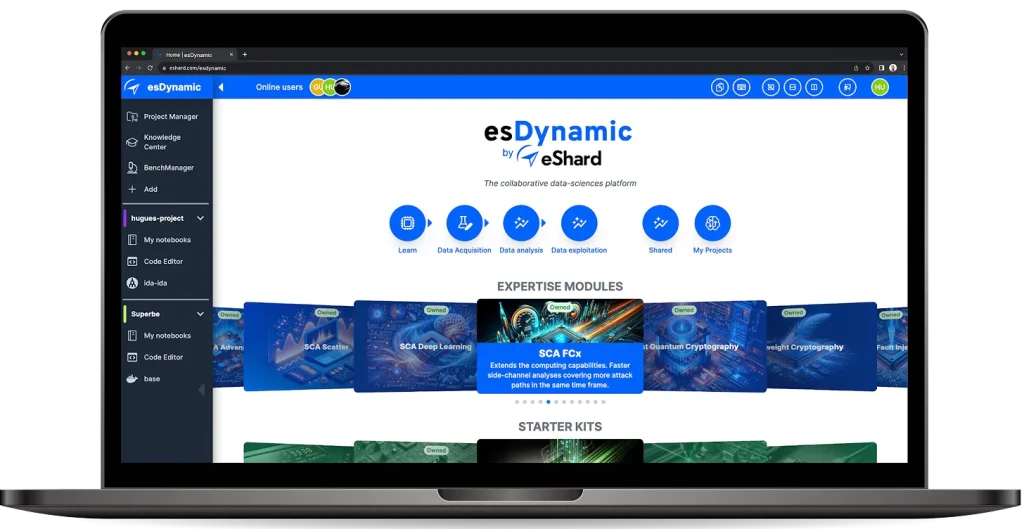
esDynamic brings equipment, data, analysis and knowledge into one platform. Analysts access them from their desks.
A campaign in esDynamic follows the same steps for each attack:
Several analysts can use the same lab equipment remotely, share acquisitions and work on the same project at the same time. The team shares the bench instead of accessing it through one person's workstation.
Each investigation keeps its own data, configuration and results. You can switch between analyses without rebuilding your environment. You can also return months later and continue where you left off.
esDynamic uses JupyterLab and standard Python. Analysts can write their own scripts and algorithms without restriction. They can send demanding processing tasks to servers, GPUs or distributed computing. This supports side-channel work that routinely involves aligning, filtering and analysing millions of traces.
esDynamic controls eShard hardware and third-party instruments through one Python API or dashboard. These include oscilloscopes, fault injectors, probes, motorized stages, infrared cameras and custom equipment. Recent releases added native support for Thorlabs instruments and Rohde & Schwarz oscilloscopes.
The Insight visualiser handles traces from about a thousand samples up to hundreds of megasamples without freezing. You can overlay traces and apply filters and alignment with instant feedback. An open Python API lets you control it from notebooks.
Administrators can oversee many investigations, teams and environments in one place. They can also control access and organise documentation. A user panel and licence manager handle accounts, permissions and resource usage.
| Technique | What it tests | Pertech page |
|---|---|---|
| Side-channel analysis | Whether crypto leaks secrets through power or EM emissions. AES, RSA, ECC and post-quantum, from CPA to deep learning, at all orders | Side-Channel Analysis |
| Electromagnetic fault injection | Resistance to EM pulses, with spatial and timing control | EM Fault Injection |
| Laser fault injection | Resistance to precise optical faults, from backside imaging to exploitation | Laser Fault Injection |
| Voltage and clock glitching | Resistance to power and clock disturbances, with parameter sweeps | Glitching Fault Injection |
| Photonic emission analysis | What a chip reveals through emitted light | Photonic Emission |
| Physical attacks in emulation | Side-channel and fault behaviour of firmware, before silicon | esFirmware |
esDynamic includes eShard's attack methods as executable notebooks. Teams can start with proven methods:
esDynamic fits several situations. The right purchase depends on your lab's current setup and needs:
Pertech helps you choose between these options and combine them as your lab grows.
Pertech is eShard's partner in Israel. We help define the lab around your targets. We help you choose a turnkey lab or add esDynamic to your existing equipment. We also arrange engineer training, install the platform on-premise and provide local support.
The esDynamic hardware security platform is eShard's on-premise platform for hardware security testing. It controls lab equipment, runs side-channel and fault-injection campaigns, and stores data and results in shared projects.
esDynamic supports side-channel analysis, EM fault injection, laser fault injection, voltage and clock glitching, and photonic emission analysis. Analysts access these techniques through one interface.
esDynamic works with third-party hardware as well as eShard equipment. It controls oscilloscopes, pulse generators, motorized stages and cameras.
esDynamic analysts rarely need to be in the lab once the device under test is on the bench. They control the equipment remotely through the esDynamic server and the esBox gateway.
esDynamic handles very large side-channel datasets by scaling with your infrastructure. It can send processing to GPUs, servers or distributed computing. This helps when campaigns reach millions of traces.
esDynamic lets you use your own scripts and algorithms without restriction. It uses standard Python and Jupyter notebooks.
esDynamic supports post-quantum cryptography testing through eShard's PQC modules. They cover ML-KEM, ML-DSA and FrodoKEM, with more than 20 notebooks including fault attacks. eShard used the modules in its evaluation of PQShield's ML-KEM hardware IP.
An eShard starter kit includes target hardware, the software environment and guided notebooks for a specific attack. Examples include AES key recovery on an STM32 or i.MX8.
Several teams can share one esDynamic installation. The Project Manager lets administrators oversee many investigations, teams and environments, with access control for each project.
You can buy esDynamic from Pertech Embedded Solutions, eShard's partner in Israel. Pertech handles quotes, installation, training and support.