
eShard’s glitching lab tests chips using voltage glitching fault injection and clock glitching. It applies brief, deliberate disturbances to a chip’s power supply or clock. Glitching is often the first fault-injection technique a team adopts. It needs relatively simple equipment and works on many microcontrollers and SoCs.
For a few nanoseconds, the supply voltage dips or the clock gets an extra edge. If the disturbance occurs at the right instruction, the chip may skip a check or corrupt data. Glitching tests whether a device detects and blocks this kind of attack.
→ Full list: eShard Lab Equipment
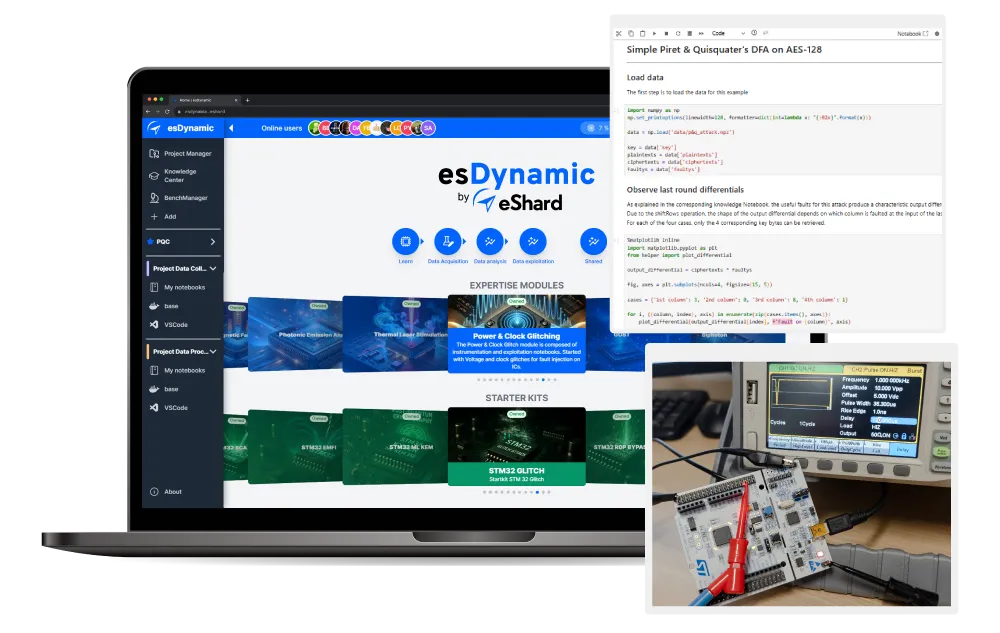
You tune three parameters: delay (time after the trigger), pulse width and amplitude or depth. esDynamic sweeps these automatically to find settings that work despite system jitter. It displays the results as heatmaps so no part of the parameter space is missed.
Secure microcontrollers, SoCs, FPGAs and cryptographic implementations.
Voltage glitching is a fault injection technique that briefly disturbs a chip's power supply at a chosen moment. The resulting fault, such as a skipped instruction, shows whether an attacker could bypass the chip's security checks.
Clock glitching inserts an irregular clock edge so the chip executes an instruction incorrectly. It tests the same kinds of weaknesses as voltage glitching, through the clock input. eShard's glitching lab covers both.
esDynamic sweeps the trigger delay, pulse width and glitch amplitude or depth in eShard's glitching lab. It plots the results as heatmaps.
esDynamic lets you use your existing power supply and signal generator with eShard's glitching lab. It controls bench equipment from any vendor through one interface, alongside eShard hardware.
You can buy eShard's glitching fault injection lab from Pertech Embedded Solutions, eShard's partner in Israel.