
Micsig · SigOFIT™ Gen 3 · MOIP Series · Sold in Israel by Pertech
Optical-fiber isolated probes that measure ±10 mV to ±20 kV with reference-grade fidelity — built to check whether every other probe on your bench is telling the truth.
Overview
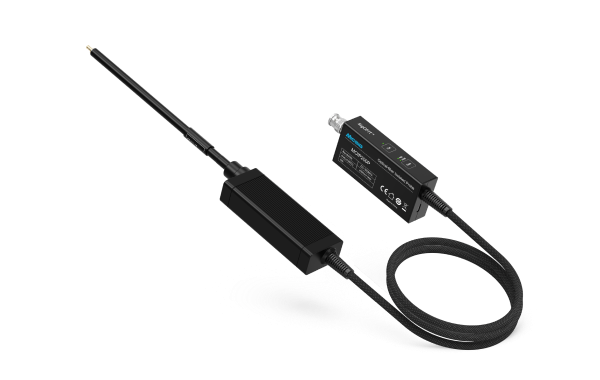
The Gen 3 SigOFIT™ optical isolated probe — Micsig's MOIP series — spans 200 MHz to 1 GHz and measures differential signals from ±10 mV up to ±20 kV. It's built around Micsig's own optical isolation architecture, which pushes CMRR to 128 dB at 100 MHz while holding isolation up to 85 kV and noise under 0.3 mVrms. Where a standard differential or voltage probe leaves you guessing whether an artifact is real or self-induced, SigOFIT shows the waveform exactly as it is — which is why engineering teams increasingly use it as the reference standard to validate their other probes against.
Why engineering teams switch
Each of these solves a specific problem the previous generation of differential probes couldn't: trustworthy readings under real switching stress, not just on a datasheet.
CMRR reaches 128 dB at 100 MHz and stays above 100 dB at 1 GHz — enough headroom to settle disputes about what your other probes are actually showing you.
Real-time optical power compensation keeps the waveform accurate through long, unattended 24/7 test runs — no manual recalibration cycle to schedule around.
DC gain accuracy within 1%, noise under 0.3 mVrms, zero drift under 0.1% after a five-minute warm-up, and gain drift held under 1%.
Nanosecond switching edges throw off high-energy harmonics. Even at full bandwidth, CMRR stays near 100 dB, so common-mode noise doesn't show up as false oscillation — no extra filtering needed.
Short coaxial leads keep input capacitance down to as little as 1 pF, so the probe itself doesn't disturb the sensitive node you're trying to measure.
Signal rides on a laser; power rides on the same fiber. No batteries to swap or drain — which means truly continuous testing, day after day.
Swap attenuator tips to cover everything from ±10 mV to ±20 kV differential, with full-range output and signal-to-noise ratio that holds at both extremes.
No warm-up ritual to plan around — AutoZero finishes in under a second, and the probe is measuring accurately right after power-on.
Where it's used
If your test setup involves fast switching, high common-mode voltage, or floating measurements, SigOFIT is designed to be the probe you trust when the others disagree.
Model comparison
All four models share the same optical isolation core, DC gain accuracy, common-mode voltage range, and universal BNC interface — the difference is headroom.
| Model | MOIP1000P | MOIP500P | MOIP350P | MOIP200P |
|---|---|---|---|---|
| Bandwidth | 1 GHz | 500 MHz | 350 MHz | 200 MHz |
| Rise time | ≤ 450 ps | ≤ 800 ps | ≤ 1 ns | ≤ 1.5 ns |
| CMRR (DC / at bandwidth) | 180 dB / 108 dB | 180 dB / 114 dB | 180 dB / 118 dB | 180 dB / 122 dB |
| Noise | < 0.3 mVrms | < 0.3 mVrms | < 0.3 mVrms | < 0.3 mVrms |
| DC gain accuracy | 1% | |||
| Common mode voltage range | 85 kVpk | |||
| Interface | Universal BNC | |||
| Differential voltage range | ±10 V to ±5,000 V standard/optional tip sets (MMCX/MCX/LCX), with an optional ±10 mV tip and an optional ±5,000 V–±10 kV extended tip depending on model — full attenuator list available on request. | |||
Pertech is Micsig's authorized reseller in Israel. Tell us your voltage range, bandwidth, and switching device, and we'll spec out the right MOIP configuration and attenuator tips for your bench.
Pertech Embedded Solutions · Ra'anana, Israel · pertech.co.il